
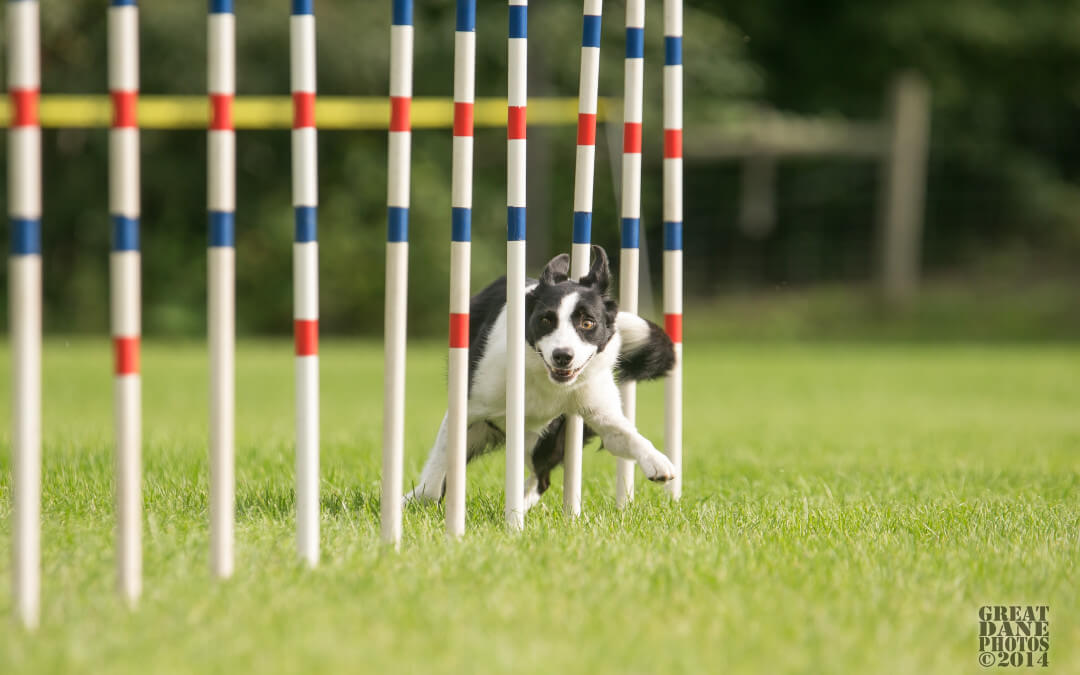
Photo by Great Dane Photos
We have an exciting spotlight to share with everyone on longtime club members, Jim and Gina. The first to join was Gina in the mid 90’s, after she met some people from TCOTC at the Humane Society in St. Paul, MN. The people from TCOTC would come in to work with the shelter dogs on the weekends. Gina thought that was cool, so she started to bring one of the shelter dogs at the Humane Society to TCOTC. Before long Gina was coming to the club with her own dogs to the club. Jim came along later when Gina started taking the dogs to agility and flyball programs, which are a lot of fun to watch.
Over the years Jim and Gina became friends with former club president Nanette Malcomson through flyball classes. TCOTC had recently taken over the annex space, and after one night of classes the agility program was already expanding fast. Nanette knew about Jim and Gina’s success in agility. So of course she asked them if they would like to start teaching agility classes. Gina felt it was a great way to give back to the club that had given her so much, and ever since Jim and Gina have been at it.
Currently Jim and Gina have two dogs, Trek and Abbey. All of their dogs have been rescues, and Trek and Abbey are no exception. Trek is involved in agility and flyball, while Abbey does both of those along with herding. Even great instructors can have issues with their own dogs. For Jim it’s with Trek who refuses to weave in public. At home and in classes Trek loves to weave, and looks for any opportunity to weave. However, when Trek gets to a trail he’s like, “what are those poles sticking out of the ground?” Which can be a frustrating experience for any handler, but hopefully someday Jim, Gina, or someone will figure out what is going on in Trek’s head. For Gina and Abbey it is tough to time commands properly, because Abbey is so fast in agility. Within a nanosecond Gina needs to make sure she times the commands along with visual cues, making sure she is facing the right direction, looking in the right direction. In flyball Abbey is afraid of passing all the big black dogs. Also in herding Abbey’s not always the confident, and she’s very sensitive to pressure. Also sheep are smarter than people think, and they know when a dog isn’t really going to make them do something.
When asked what was the last thing that one of the dogs did that made them laugh, and Jim said, “Every morning, Trek will grab a toy and try to get me to play with him. I’ll throw the toy, he’ll fetch it, I’ll throw it again, he’ll fetch it again; I think he’d play forever. This morning, when I got tired of throwing the toy, I took it and set it on an end table. He looked at it, looked at me, looked at it again, went and got it off the table and brought it to me. I took it and set it on the end table again, hoping he’d leave it alone. Nope – look at it, look at me, look at it, go get it and bring it back. I had to laugh when I finally figured out that, while I was trying to end one game, he was having fun starting up a whole new one!” Gina’s last funny moment with Abbey was when she was at the vet clinic and tried to turn the doorknob with her nose to escape the exam room. Dogs are too smart, and too funny.
Some advice that Jim and Gina have for new students is to have fun and more importantly make the training fun for your dog. “Your dog didn’t sign up for the class or drive itself to class. Your dog is only there because you wanted him or her to be there. And, just like people, they learn so much faster and retain so much more when they’re having fun,” says Jim. A couple more tips to keep in mind are that most of the mistakes that are made along the way are the human’s fault, not the dog’s fault. Also that your dog won’t remember your mistakes, so try returning the favor. Overall Gina says to take a look at training from the dog’s perspective. All of the activities should be joyful for the dogs, as it is about building a relationship with your dog.
Some advice for people who have trained dogs in the past can be summed up in a long-running agility joke. The joke tells how many people ruined their first dog, since the human didn’t know what they were doing the first time around, but now they know what they are doing for the next dog. However, it turns out that the new dog is just as clueless as the first dog and many people forget that. Many almost expect to pickup where the first dog left off, or we forget that many dogs learn on different paces, get motivated by different things, and simply that some dogs enjoy doing certain things over others. Gina started out agility with Maggie, who was a pretty tough dog. Maggie would tell Gina whenever she was wrong, late, or unclear with her commands. This forced Gina to be quieter and a little tougher. Then when Shep came along, Gina had to learn to be softer and goofy, just like Shep!
Getting students out of their comfort zone to try new things can be a challenge for Jim and Gina as instructors. People are like dogs as no two are the same. Jim and Gina have been lucky to have students who understand that nothing is going to happen overnight. Even still it can be tough to get a student for example in agility to try a rear cross instead of a front cross when they are not comfortable with doing a rear cross. Fortunately, most people finally give in and try a new move that takes them out of their comfort zone, though some take some more cajoling than others, some need a challenge (“Hey, look – Julie did it! I bet you could too!”), and some need a financial incentive (yes Jim has been known to offer people as much as $0.25 to try something). When the student finally tries the new move, it doesn’t always go as well as they’d hope. But it is important to know that trying a new move once is not the same as training it, training takes time and practice. Also many of us Midwesterners are low-key people. Gina sees herself having to get people to work on being fun and goofy.
When asked about success stories, Jim and Gina said that there is success that happens every week in class. The hardest part is to sometimes get the student to recognize the success! Agility involves a ton of little things that all need to come together to be successful. Keeping the bars up, touching all of the contacts, speed, staying on the course, and communicating a ton with your dog. Jim loves to see a team do something well, tell them how good it was, and hear the student say “yeah, that was good, wasn’t it!”. There aren’t any ribbons or placements in class, just you and your dog working together. It is truly special when the handler realizes how well the team is working together. That is a success.
A success story that really stuck with Gina was with a Bichon that joined the class. They were warned that she would often run off and sniff, and wouldn’t go back to her handler. Sure enough when the Bichon came to class that’s exactly what happened. After watching a few weeks Gina figured out that this dog started doing this when they asked her to repeat sequences. The Bichon didn’t know that it was ok to ever be wrong. They started doing a lot of short sequences, various rewards, worked on some free shaping outside of class, and worked with her handler to never let the dog know she had done something wrong. The Bichon has gone on to earn titles in a couple of organizations, but more importantly she now continues to work even if she does something wrong.
A success story that Jim had with one of his own dogs was with his first agility dog Kip, a consistent border collie. Kip was not very fast, but Kip was consistent. They had problems making course time on a Jumpers course in agility. Kip was more concerned with doing everything right, so he was methodical. Jim’s challenge was to make things more fun for him so that he would loosen up and run. So Jim became the “King of Front Crosses” to try to get Kip to chase him through a course. And Kip started to learn to run and to be right at the same time. Kip went on to win 10 or so NADAC Agility Trial Championship awards and one time even finished in the top 10 elite level dogs at the National Championships.
As for Gina, her dog Maggie was a great teacher, sticking out as a great success story. Maggie was a tough dog for a newbie handler, but she taught Gina a lot about dog behavior. When they stared agility she would get frustrated when Gina would give late commands. To the point where Maggie would get frantic and come back nipping. Maggie taught Gina to be calm and quiet and to start every run with a slow breath. They eventually learned to work well together as a team and earned multiple trial championships.
For new instructors, remember that the word “instructor” is not another word for “expert”. Odds are very good that you are not both. As an “expert”, there’d probably be very little you could lean from your students. As an “instructor”, you have a head start, but there is still a ton you can learn from your students. So paying attention to students is key, and of course have fun! Gina really hates to see people shut down their dogs. If a dog is the type that is cautious and always wants to be right, Gina’s goal is to get them to run off course with gusto!
Jim and Gina even sort of teach agility classes together (students should beware that they share notes on the way home!). They both have a main goal of making class fun, and figuring out ways to make each team work together as a cohesive unit. Jim believes that Gina is more dog smart than he is. Gina says that Jim is more in tune with handling issues, while she is more in tune with the dog issues. Creating a nice balance between the two of them as instructors. Gina says she would probably be bored if she ever had a dog that would correct itself every time Gina showed poor handling, but every once and a while it would be nice.
Gina has been involved in rescues for many years. She started out as a volunteer for the Humane Society. Walking dogs, fostering, organizing pet adoption days, and participating in fundraising events for about 9 years. That started to become difficult when Gina’s schedule started to get filled by agility trials. So she began working with Border Collie rescue. Gina mainly does phone interviews, home visits, and fostering. If you would like to get involved in rescue groups there are a variety of things you can do. Some of the areas that fosters need to help with are phone interviews, transportation, dog evaluations, home visits, fundraising, website design/updates, and writing thank you notes. Taking a look at Petfinder.org, you can find just about any rescue group in the State and get a link to their own website. Most will have a portion of their site that will tell you about how to become a volunteer, and what you can help with. Not everyone is cut out to foster. It can be tough to let the dog go, but Gina always goes into it knowing its her job to get the dog placed in a home so she can help rescue another one in the future. Gina is involved in Border Collie rescue because they are a breed that really needs help from people who understand what makes them tick.
We would like to thank Jim and Gina for all they have given to everyone at TCOTC. This spotlight shows just some of their magic. Here’s to many more years to come at the club!