
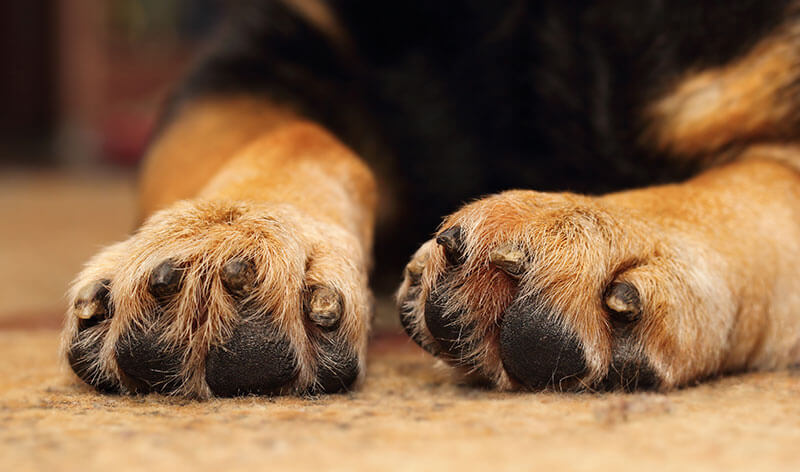
Have you ever heard that dogs who love to swim have webbed feet? And have you ever stopped to ask yourself “What exactly are webbed feet, anyway?” Do water-breeds (like American Water Spaniels, Portuguese Water Dogs, etc.) really have anything different about their feet compared to non-water breeds?
A group of us at the University of Minnesota’s College of Veterinary Medicine asked ourselves these same questions and realized that there is no scientific definition of “webbed feet”. All dogs, no matter the breed, size, or like/dislike for water, have tissue between their digits. So, what makes a dog foot “webbed” … or not? Searching the scientific literature brought up zero answers, and, to make the situation more confusing, a breed that typically loves the water, and is usually considered to have webbed feet – the Labrador Retriever – does not even have the word “webbing” in its official AKC breed standard.
Therefore, we set out to scientifically investigate these questions, and TCOTC, due to its proximity to the University of Minnesota, and the large number and variety of events held there, was a great place to start. We’ve collected data at three TCOTC events already, and we hope to come to more. The data we are collecting is entirely non-invasive and non-painful for the dog, although it helps if the dog isn’t too ticklish about having his/her feet touched. We measure the dog’s height (unless the dog already has an AKC height recorded), and then take about a dozen measurements of the feet, including the length of the tissue between the dog’s toes. We also collect a cheek swab for potential future DNA studies; these are not slated to start anytime soon, so right now they’re just being banked. Literally any dog can be enrolled, as long as he/she is over one year of age. The study welcomes purebred dogs, mixed-breed dogs, and unknown breed dogs – literally any dog! This is because, when we start analyzing data, we will need to make comparisons between breeds (comparing water breeds with non-water breeds), and we also want to compare water breeds to size- and weight-matched dogs that are of mixed or unknown breed.
We have not analyzed any data yet, because the scope of this study is big – we still need to enroll many, many (literally hundreds) more dogs! Thus, we can’t yet report any preliminary findings. You may see us at an upcoming event at TCOTC – if you do, please enroll your dog! Or, we can also accommodate enrolling dogs outside of specific TCOTC events; we will simply have you come to the laboratory, located in the College of Veterinary Medicine on the U of MN’s St. Paul Campus. Let us know if you happen to be in our neighborhood – it only takes about 10 minutes to collect the data from each dog. Contact: Dr. Kari Ekenstedt: eken0003@umn.edu